
MHADA Redevelopment Plan: Big Shift in Mumbai, Pune & Nashik Real Estate Market
Published on June 8, 2026
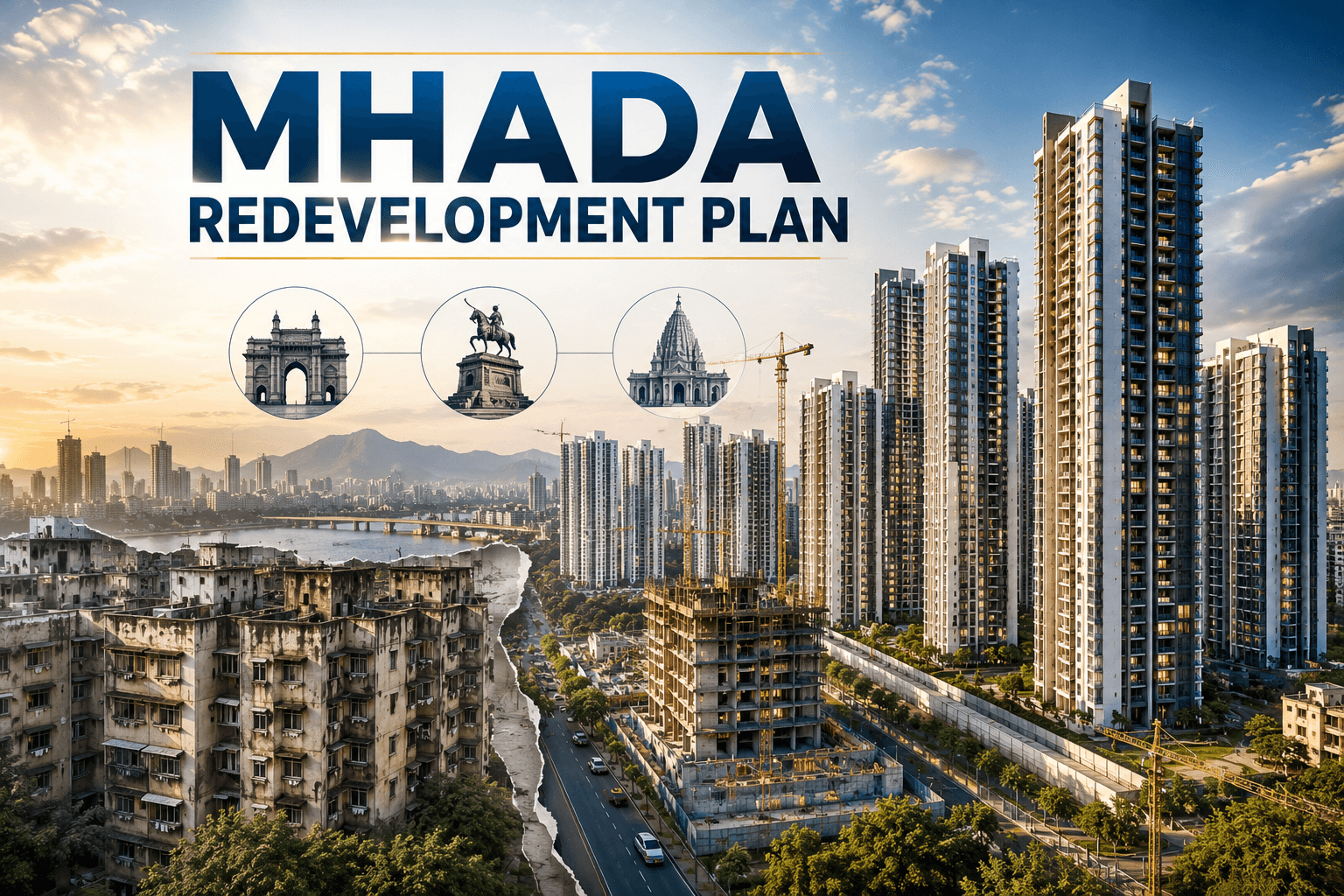
Maharashtra Housing and Area Development Authority (MHADA) has initiated the redevelopment process in prominent urban centers, such as Mumbai, Pune, and Nashik. The primary objective is to restore unsafe and old housing layouts and construct new residential buildings.
The vast majority of these housing schemes are over 40-45 years old. Numerous buildings are in immediate need of structural repairs. However, MHADA is not just repairing them, but redeveloping them.
This will enhance safety, provide more housing, and utilize prime city land. This step will directly affect Mumbai redevelopment projects, help in Nashik real estate development, and promote real estate redevelopment activities in Maharashtra.
Why This Redevelopment Plan Is Important
There are already some cities, such as Mumbai, that suffer from a shortage of land. There is little space available for construction. As a result, redevelopment is the only viable option.
According to MHADA, it is their belief that the old housing areas in prime locations should not remain underutilized. The land can be rebuilt and produce more homes with better facilities.
This also contributes to a good life. There are a lot of buildings that have not met the safety standards, and there are no parking spaces or modern facilities for many of the old buildings.
Redevelopment addresses these problems and does so in a planned manner.
Key Focus Cities Come Under in the MHADA Plan
The redevelopment plan is mainly focused on three important cities. The role of each city is different in this strategy. However, the city of Mumbai is still the greatest concern due to the presence of a large number of old and densely packed housing colonies.
Here, many of the cess buildings and MHADA layouts await redevelopment for years. Pune is also experiencing a moderate growth rate. The city is growing rapidly, and older neighborhood pockets are now being targeted for redevelopment.
Nashik is gradually entering this growth cycle. The city is getting noticed for its infrastructural development and increasing demand for housing, although the scale is smaller.
The True Purpose of MHADA
Construction is not the primary objective. It is a full urban renewal. The old neighborhood plans will be taken down, and new modern buildings will be put up. These are new projects that will feature upgraded designs, improved structures, and improved facilities.
The challenge for MHADA is also to strike a balance between development and affordability. Some of the new housing will be set aside for affordable home buyers.
Meanwhile, private developers will be key to implementation. This accelerates work, and the burden on government finances is lowered.
Rental Housing Plan for Urban Demand
One of the most important updates in this redevelopment strategy is rental housing.
MHADA is developing a rental policy to support rental homes for:
Students
Working professionals
Senior citizens
Short-term city visitors
For the time being, developers stay away from rental housing because they're seeing lower returns than they would in regular developments.
The average return for rental projects is typically 4-4.5%, whereas the average return for a normal real estate project is much higher.
To address this, MHADA is proposing incentives for developers to make rental housing attractive. This might change the urban housing model in India if it is successful.
Upcoming Redevelopment Projects
There are a number of large redevelopment schemes currently in the planning phase and likely to be tendered soon.
Examples of such projects are high-value locations like Motilal Nagar, BDD Chawls, Kamathipura redevelopment zone, Adarsh Nagar in Worli, Bandra Reclamation, and SV Nagar.
All these areas are in the prime part of Mumbai, and the Land value in those areas is very high.
These projects are expected to have a significant impact on the overall appearance and function of the city, creating a more modern and inclusive atmosphere for residents and visitors alike.
Market Impact on Real Estate
The redevelopment program by MHADA will impact the real estate market directly. This will have one major impact: more housing supply in already built-up areas.
This implies that there would be more residences in the centers rather than spreading out the city. This is particularly crucial for those looking to invest in properties in Mumbai, where demand is always high, while supply remains low.
It can also be used to regulate some price fluctuations of a micro-market that would have been sudden otherwise, as new supply will be introduced in a planned way.
Redevelopment in Pune and Nashik will enhance the living standard, and housing areas will be more organized. This will help these cities to grow in the long run.
Strong Financial Situation Behind the Plan
In recent years, the financial situation of MHADA has greatly improved, and its capacity for development has been significantly strengthened. The previous figure of its funds was around ₹150 crore, prompting smaller sizes and speed of projects.
Currently, the total is over ₹5000 crore. This increase was primarily due to developer premiums collected from redevelopment projects throughout Maharashtra. The premiums are a significant source of income for MHADA.
Now, with this solid financial foundation, MHADA is in the position to undertake large-scale redevelopment projects without significant funding delays.
It also enhances the execution speed for future redevelopment projects in cities such as Mumbai, Pune, and Nashik.
The Role of Private Developers and Industry Trend
In recent times, private developers have played an important role in the redevelopment projects of the MHADA.
MHADA is collaborating with them in accelerating the building process and managing the reconstruction of houses on a larger scale in urban areas such as Mumbai.
Developers contribute capital, expertise, and have the ability to execute the project more quickly, and the developers also receive redevelopment rights and a share of the new housing. This helps the projects to be viable for both sides.
Overall, the real estate market is clearly moving towards real estate redevelopment as a consequence of the limited supply of new land in cities and high demand.
This is particularly the case in redevelopment projects in Mumbai, where old structures can command a high price when they are reconstructed.
Simple Market Outlook
The redevelopment pipeline is expected to slowly increase housing supply over the next 10–15 years. This will not result in sudden changes, but will gradually alter the appearance of the city.
Demand for housing from MHADA is also very high. Even in recent lotteries, lakhs of applications have been received for thousands of homes, which indicates a high level of interest in affordable housing.
This high demand and limited supply will sustain the market's activity and stability.
Conclusion
The redevelopment plan undertaken by MHADA is an excellent initiative to upgrade the housing sector in Maharashtra. The authority is working on the old buildings in Mumbai, Pune, and Nashik to create an urban renewal model for the long term.
This plan will include enhancements and additions to safety, housing, and investment opportunities in prime locations.
It also empowers redevelopment projects for Mumbai, real estate development in Nashik, and enhances the real estate development activity across the state.
This project will go on to be one of the most critical factors in urban development in Maharashtra during the next few years.